Welcome
If a book truly interests me, I cannot follow it for more than a few lines before my mind, having seized on a thought that the text suggests to it, or a feeling, or a question, or an image, goes off on a tangent and springs from thought to thought, from image to image, in an itinerary of reasonings and fantasies that I feel the need to pursue to the end, moving away from the book until I have lost sight of it. Even if, of every book, I manage to read no more than a few pages, those few pages already enclose for me whole universes, which I can never exhaust. —Italo Calvino
Dear Listeners, onstage and off,
In shaping relationships for Yellow Barn, I feel obligated to go to any length to cultivate independence in those that come to listen, an independence free from information that hints at a hierarchy of “knowing”, or the myth that “expertise” deepens our connection to art. In this way, an audience of individual listeners is created, each of whom brings their inimitable sensibility into the concert hall relationship. The artist and the non-artist are equal in this, for any walk of life can be imbued with artfulness; that is, with a care that is manifested with love and connects us with the most transcendental questions.
The genesis of visual, literary, and musical art, all share the foreshadowing of a transformative process, from the moment the artist confronts an unformed idea, and in their creative process, lifts it to artistic expression. With music, the interpreter takes the “instructions” of that expression and strives to return to the composer’s original impulse, the least performance-like representation of that expression. This is how we must communicate with the listener: in the least performance-like performance possible, so that they too can confront that original creative impulse.
Pianist Artur Schnabel from a series of lectures he notably called “Music and the Line of Most Resistance”: The greater a musical work of art, the more will it include of the total expressive potency of music. This fact explains why persons related to music by grace contemplate, perform, and hear a work familiar to them at the next stage of their development as a work in many respects different from what they believed it to be before.
If we believe this to be true, don’t we all—composer, performer, and listener alike—become more art-full as we grow in our relationship with a work, and by extension made closer to finding the art in ourselves? What we think of as music’s singular disadvantage, the impossibility of any illusion of adequately describing it with words or translating it into reliable visual representation, may in essence be music’s distinct advantage. It is what prevents a work from becoming fixed in our imagination and makes transformation possible.
In welcoming you to Yellow Barn, I wish you a summer filled with Calvino’s “tangents”, “reasonings”, and “fantasies” as you listen, while holding this from Mr. Schnabel close, both inside and outside Big Barn: Art is not an occasional refuge or a holiday, but a perpetual and inexhaustible mandate to our spirit.
—Seth Knopp, Artistic Director
Spring 2026 Newsletter
Contents
I. Upcoming Deadline: Yellow Barn's New Residency Program
II. "Not-Knowing"—An introduction to our April 12th Concert in Boston
III. Previewing our upcoming garden & buildings campaign
IV. Video excerpts from our January Artist Residency concert
Dates of Note
March 12—Last call for Yellow Barn's audience survey Complete this 5-minute survey
April 1—Application Deadline: Residency for Non-Professional Musicians
April 12—Music For Food Partnership Concert (Boston, MA)
November 7—Yellow Barn at Wigmore Hall (London, England)
2026 Summer Season
Tickets on sale April 1st | Sign up for updates
Young Artists Program Concerts: June 21-July 3, 2026
Yellow Barn Festival Concerts: July 10-August 8, 2026
Helena Tulve, Composer in Residence: August 3-8, 2026
Yellow Barn's NEW Residency Program
Yellow Barn Residency for Non-Professional Musicians
for serious avocational string players and pianists
Seth Knopp, Artistic Director
October 10-18, 2026
Application deadline: April 1
More information

Yellow Barn's campus at the Greenwood School
This fall, Yellow Barn will embark on a new adventure: a one-week intensive for serious avocational musicians wishing to explore the magic of chamber music led by Yellow Barn festival faculty and guest speakers from a variety of fields.
Over a week in October, selected musicians will work with faculty in pre-formed groups, exploring great works from the chamber music canon. The goals of this session are several: to embrace the community of avocational musicians who approach music with seriousness of purpose and passion, but who chose not to make it their profession; to focus on the greatness of the music itself, rather than solely performance or presentation; and to cultivate a community of musicians and supporters who can experience the magic that is Yellow Barn. The intensive is aimed at the original definition of the word "amateur": one who loves music, rather than the modern notion of a non-professional musician. If successful, the hope is to repeat this program each year, furthering Yellow Barn's reach into the community of music lovers.
—Steven Frucht, Board Member and Residency Guest Speaker
"Not-Knowing"—An Introduction to our April 12th Concert
Music for Food Partnership Concert
Sunday, April 12, 2026
7:00pm | New England Conservatory of Music, Boston
All proceeds will support Women’s Lunch Place
Program includes Beethoven's An die Hoffnung, Olivier Messiaen's Quatuor pour la fin du Temps (Quartet for the End of Time), and works by Kurtág, including selections from Játékok (Games) and Schumann's Kinderszenen, with transcriptions of J.S. Bach
This past summer at Yellow Barn, two sets of pieces were programmed that are most often described as “pedagogical”: Luciano Berio’s Duetti and György Kurtág’s Játékok (Games). After all, both Berio and Kurtág indicated as much. Still, you might justly ask what makes these pieces “pedagogical”, and Johann Sebastian Bach’s two- and three-part Inventions, or his Goldberg Variations for that matter, not pedagogical.
I would hazard to say that “pedagogical” has come to represent works, or an approach to learning them, that is purely “educational” …uh-oh, another one! And maybe both Berio and Kurtág would ask what the quibble is, but I believe that they would also say that Bach’s two- and three-part Inventions and his Goldberg Variations, and everything else he wrote are also “pedagogical”, and that, in fact, so are every one of their works!
Berio says that his Duetti are composed with all levels of violin playing in mind, and we automatically assume that learning is a one-way street, the accomplished leading the less accomplished, the knowing teaching the un-knowing.
But about his Játékok, Kurtág writes:
The idea of composing games was suggested by children playing spontaneously, children for whom the piano still means a toy. They experiment with it, caress it, attack it and run their fingers over it. They pile up seemingly disconnected sounds, and if this happens to arouse their musical instinct they look consciously for some of the harmonies found by chance and keep repeating them. Thus, this series does not provide a tutor, nor does it simply stand as a collection of pieces. It is a possibility for experimenting and not for learning “to play the piano."
How advanced we are at “playing the piano” does not assume a correlation with how we convey “meaning” to an audience. In fact, Kurtág seems to imply the opposite may often be true!
“… a possibility for experimenting and not for learning “to play the piano”.?! Should this not be true of all music? And if it is true for all music, what purpose does the word “pedagogical” serve other than the context in which we encounter it, or how we ourselves are enlightened by it?
Enjoy reading what the writer Donald Barthelme, and Luciano Berio have to say about “knowing” and “meaning” in their 2 pieces below.
—Seth Knopp
From Donald Barthelme’s Not-Knowing:
Let us suppose that someone is writing a story. From the world of conventional signs he takes an azalea bush, plants it in a pleasant park. He takes a gold pocket watch from the world of conventional signs and places it under the azalea bush. He takes from the same rich source a handsome thief and a chastity belt, places the thief in the chastity belt and lays him tenderly under the azalea, not neglecting to wind the gold pocket watch so that its ticking will, at length, awaken the now sleeping thief. From the Sarah Lawrence campus he borrows a pair of seniors, Jacqueline and Jemima, and sets them to walking in the vicinity of the azalea bush and the handsome, chaste thief. Jacqueline and Jemima have just failed the Graduate Record Examination and are cursing God in colorful Sarah Lawrence language. What happens next?
Of course, I don't know.
It's appropriate to pause and say that the writer is one who, embarking upon a task, does not know what to do. I cannot tell you, at this moment, whether Jacqueline and Jemima will succeed to jimmy the chastity belt's lock, or whether the thief, whose name is Zeno and who has stolen the answer sheets for the next set of Graduate Record Examinations, will pocket the pocket watch or turn it over to the nearest park employee. The fate of the azalea bush, whether it will bloom or strangle in a killing frost, is unknown to me.
A very conscientious writer might purchase an azalea at the Downtown Nursery and a gold watch at Tiffany's, hire a handsome thief fresh from Riker's Island, obtain the loan of a chastity belt from the Metropolitan, inveigle Jacqueline and Jemima in from Bronxville, and arrange them all under glass for study, writing up the results in honest, even fastidious prose. But in so doing he places himself in the realm of journalism or sociology. The not-knowing is crucial to art, is what permits art to be made. Without the scanning process engendered by not-knowing, without the possibility of having the mind move in unanticipated directions, there would be no invention.
This is not to say that I don't know anything about Jacqueline or Jemima, but what I do know comes into being at the instant it's inscribed.

...read the rest of Berio's program note here
Previewing our upcoming Garden & BUILDINGS CAMPAIGN
Sign up for project and campaign updates
During the first week of March, every town in Vermont gathers for its annual Town Meeting to vote on town leaders and finances, and to learn more about vital programs. (Even Aleksandr Solzhenitsyn had to attend Town Meeting in Cavendish, Vermont to propose a chain link fence for his property.) This year's presentation in Putney included a preview of Yellow Barn’s evolving plans for the Big Barn property on Main Street.
With our priorities, project collaborators, and timeline in place, Yellow Barn is preparing to launch an 18-month campaign later this spring. In December, we received a lead gift to create a percussion studio and play garden next to the Putney Public Library, and to purchase much-needed percussion instruments. The percussion studio, complete with its new family of instruments, will open this summer.
Next we are focusing on safety, accessibility, and mobility throughout the property, starting this summer with improved accessible parking options, and continuing this fall with graded, well-lit pathways, plus—after this particular winter—snow guards on our roofs. Plantings will follow, and the culminating event will be the addition of retractable glass walls to the pavilion where we serve ice cream during concert intermissions, making it a solarium, open year-round for socializing, meetings, pop-ups, and other events.

We are thrilled to announce that we are partnering with the Vermont Community Foundation to launch much-need reserve and endowments funds, each vitally important for Yellow Barn’s future. Itself a non-profit organization, VCF pools investments like ours to strengthen our state as a whole. 10% of our upcoming campaign will be directed to our reserve and endowment funds.
Click on project timeline to view larger:

Click on the pavilion to view larger:

Click on images to view priorities, projects, and collaborators:

Video Excerpts from our January Artist Residency concert
This fall and winter Yellow Barn hosted 11 Artist Residencies, including recording residencies, studio concerts, workshops, and work-in-process performances in the Big Barn. Thank you to all our audience members, especially those who inspired an added second performance on January 31st, the culmination of a week-long residency with Daniel Chong, Jessica Bodner, Daniel Anastasio, and Naomi Shihab Nye.
Enjoy these excerpts from the performance and post-concert discussion:


Fall 2025 Newsletter
CONTENTS
I. News from the Yellow Barn Garden
II. Reading From Across the Room: From the Stage to the Back Row with Bill Kelly
III. Watch performances from last summer in the Big Barn
DATES OF NOTE
Fall Artist Residencies
Thursday, November 13 at 7:30pm in the Big Barn: Sarah Rommel, cello
Friday, December 12 at 7:30pm in Sun Hill Studio: Seth Knopp, piano; Katherine Yoon, violin; Gerard Flotats, cello
Friday, December 19 at 7:30pm in the Big Barn: Ize Trio (Chase Morrin, piano; George Lernis, percussion; Naseem Alatrash, cello)
View the complete schedule of 2025-26 Artist Residencies
2026 Summer Season
Yellow Barn Festival Concerts: July 10-August 8, 2026
Helena Tulve, Composer in Residence: August 3-8, 2026
Young Artists Program Concerts: June 21-July 3, 2026
News from the YELLOW BARN GARDEN
It has been nearly a year since the first open meeting for the Putney community about our plans for a garden surrounding the Big Barn. Present that evening was garden designer and longtime Putney resident Gordon Hayward. Gordon, who has been a friend of Yellow Barn since its earliest years, generously embraced the process of bringing together our evolving ideas for Yellow Barn "inside out", the initial plan that we created together with landscape architect Chris Donohue at Michael Van Valkenburgh Associates, and the ideas and needs expressed by the Putney community at our meetings and in the Town Plan.
Gordon directed the initial uncovering of the land and its trees with arborist Bob Everingham (often introduced by Gordon as a "poet with a chain saw"). The site of the historic Putney Nursery, which was started by George Aiken about 100 years ago, our garden's stature came to light—a sentinel wolf pine in the south field, a grove of poplars near the Putney Co-op, a row of pin oaks near the back entrance, and a circle of evergreens and pachysandra near the library. We set to work clearing the property of invasive species, opening views to the Putney Co-op and Main Street, and keeping the property mowed to promote safe and enjoyable walking.
Immediately, we noticed a difference! People began incorporating our garden into their daily patterns of walking and resting, audience members approached our concerts from new directions, and arrived with open curiosity. "I have lived in Putney for 30 years... How have I never been to Yellow Barn?" was a frequent exclamation, and our hall was full every night of the season.
Just before the start of the festival, Gordon presented us with a design that shows how every need could be met on just 3.7 acres of land. It is an extraordinary gift! To see ideas come to life, made beautiful by Gordon's experience and imagination, is both humbling and energizing. His design will now inform our interpretation of Chris Donohue's plan as we strive to create a space that resonates with all of us.
The clearing of the Big Barn property, and this synthesis of ideas, marks the end of Phase I of our garden creation. Between now and the start of the annual audition tour in early January, we will finalize our strategy for building and planting. 14 individuals and families made it possible for us to purchase the Big Barn and to see all that its surrounding property has to offer. In Phase II, everyone will have the opportunity to give the gift of a Yellow Barn Garden to each other.
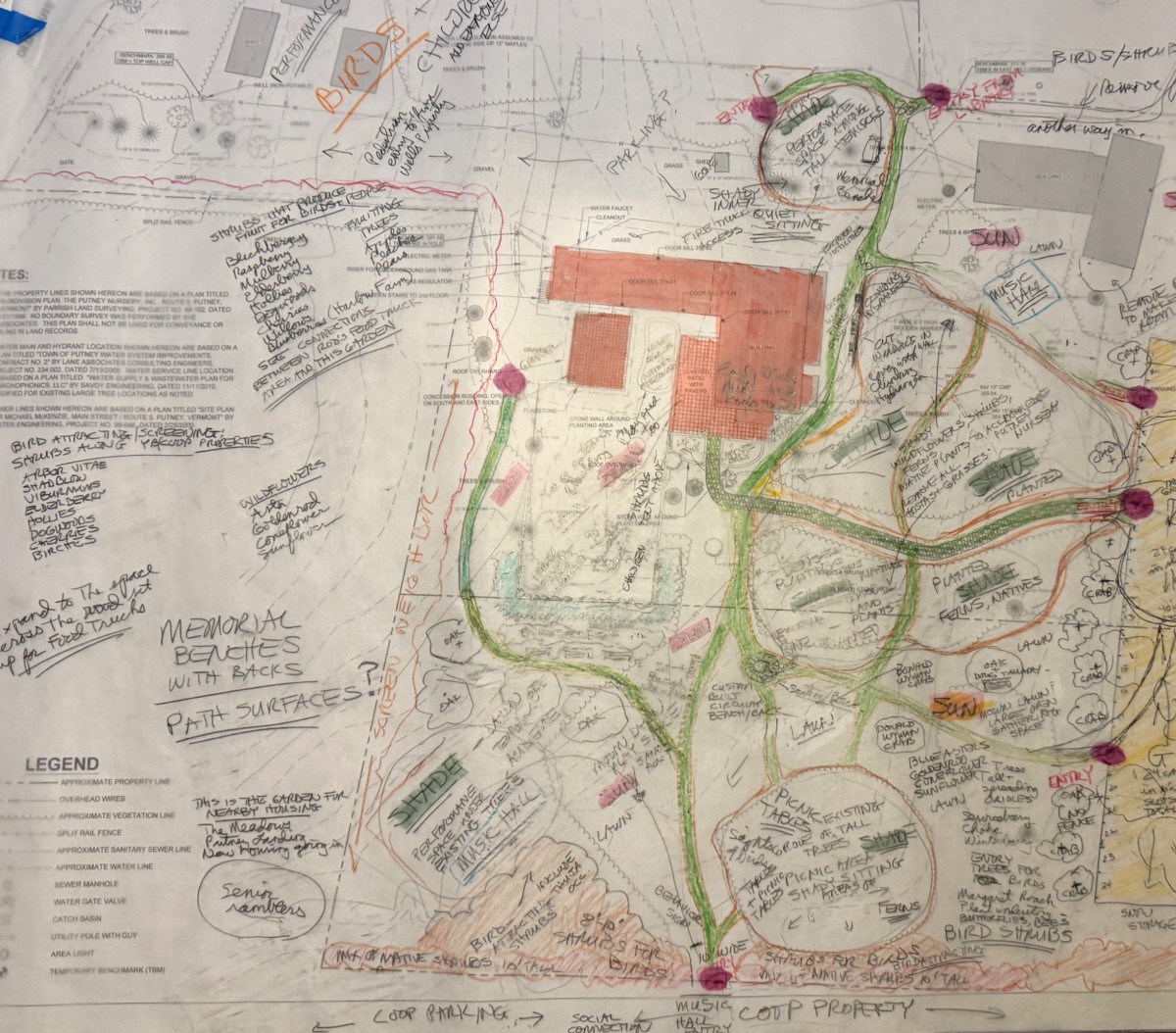
Gordon Hayward's drawing for the Big Barn property
READING FROM ACROSS THE ROOM:
From the Stage to the Back Row with Bill Kelly
Bill Kelly is a painter, printmaker, and sculptor. He founded Brighton Press, a fine press artists’ book publisher in 1980. Since 1997, he has created hundreds of “Wall Programs” and other art as Yellow Barn’s Artist-in-Residence, and you can find him sitting in the back row of almost every Yellow Barn concert.
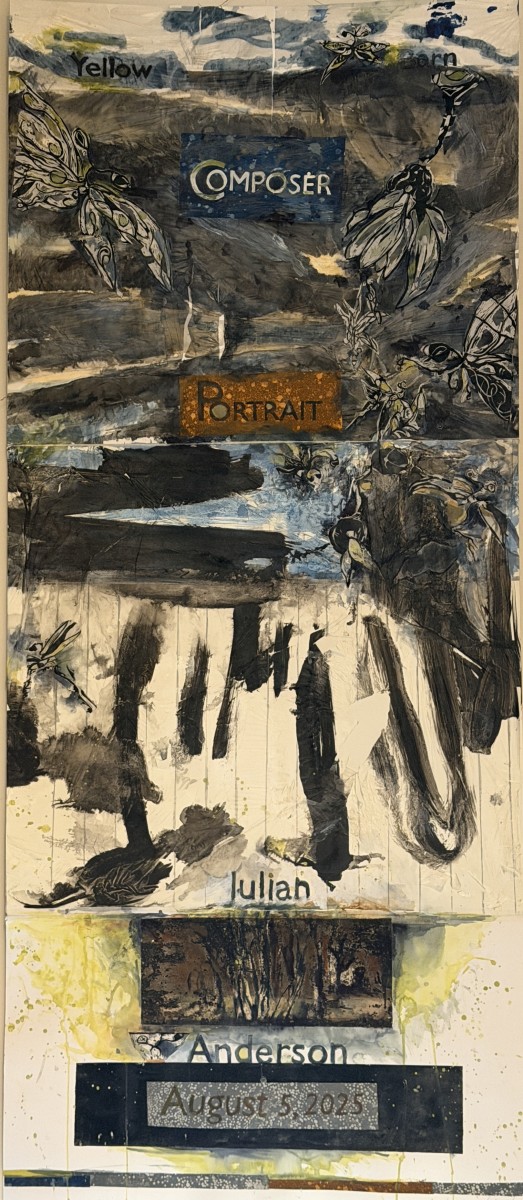
Bill Kelly's wall program from this year's Composer Portrait
"Making a Wall Program"
(Bill Kelly’s advice and ideas sent to all Yellow Barn musicians before they arrive each summer.)
Advice
It is helpful if your poster can be read from across the room.
Keep sight of things that are important in your design. Remember the unifying reason for the poster.
White-out is not a solution to a mistake like it is in typing, hence the visible traces of all of the moves an artist has made and will make.
Most art falls in a range between light and dark. There is no such a thing as black and white in art.
Do not leave dirty brushes in the sink. They are like your instruments; don’t leave them out in the rain or unattended. Make sure to use the right brush for the right job.
Ideas
-Move like a dancer, think like a poet/philosopher.
-Push, but don’t reach. I don’t know how to do this, but I keep trying.
-Don’t aim to please.
-Paint like you mean it.
-Don’t spell Haydn “Hayden” as I did once. It ruined my evening and still haunts me.
-You are part of something big, and a poster is a visual artifact of the moment. Nothing more, nothing less.
In June of 1997, just a few days after my first Yellow Barn summer had begun, I wandered over to the art studio where Bill Kelly taught painting and drawing at the Putney School. Hanging concert programs on the wall above the Yellow Barn stage was a tradition I had inherited, and it made me curious. On concert evenings simple programs were handed out, but I liked the idea that from the audience one could also choose to look through, or next to, the players to get this most basic information.
In my memory, our first meeting was as it has always been since, an easy friendship grounded in art and music. I asked Bill if his class might be interested in sitting in on Yellow Barn rehearsals and then adding “image” to our Wall Program tradition. Bill did not ask anything other than, “When do you want us there?”
These many years later, Bill’s work has become a visual metaphor of what Yellow Barn strives to be, an essential presence when we dream Yellow Barn.
—Seth Knopp
Almost nightly, as a participant at Yellow Barn concerts (by that I mean a participating member of the audience), I wonder at this complicated relationship, between being merely entertained and understanding the complex dynamic that our senses experience. In any given moment, the story that music gives us is in a sense staged, not just performed. Notes may appear static on the score, but sound is an ever-evolving story.
What I see not, I better see—
On any given night we feel familiarity and spontaneity, discord and harmony, surrendering to both sheer beauty and the mystery of the composer’s search. We hear whatever form this arrangement of invention and movement may take through the musician’s voice, and on many evenings, Seth gives us written clues, inspirations in their own original “other” form that often appear along with titles and texts. But the intimacy of scale at Yellow Barn allows us to easily connect with anybody we feel moved to approach, and I take advantage of this by taking it a step further. A conversation with a musician I have only moments ago admired from the audience is spontaneously recorded in my sketchbook:
Pianist Gil Kalish speaking of George Crumb: “George creates atmospheres of wonder. His music deals with the most important aspects of our human experience. Life, death, love and the spirit behind all of that, whether it be GOD or something more ephemeral . . . I deeply believe that his music will be heard and played for as long as there is a human spirit.”
Percussionist Eduardo Leandro takes my sketchbook and furiously writes: “There’s a character in a Milan Kundera novel that is based in gesture. Can’t remember the book’s name. Percussion is the one instrument that cannot be defined by an object, but more by a gesture. Not only hitting an object, but sometimes caressing it or being it, making my own body the object.”
The scope of what one takes in at Yellow Barn over the course of a season is resonant and powerful because of all the possibilities one is given to experience in imagery and imagination. As a visual artist I was moved to questions and inspired to create all this in my own way. Part of a grateful and thoughtful audience, I glimpse the meaning of Emily Dickinson’s poem. I cannot ask to see more than that.
What I see not, I better see—
Through Faith—my Hazel Eye
Has periods of shutting—
But, No lid has Memory—
For frequent, all my sense obscured
I equally behold
As someone held a light unto
The Features so beloved—
And I arise—and in my Dream—
Do Thee distinguished Grace—
Till jealous Daylight interrupt—
And mar thy perfectness—
—Bill Kelly
Watch performances from the Big Barn
Visit Yellow Barn's YouTube Channel to watch performances from the Big Barn, including over 50 from last summer!
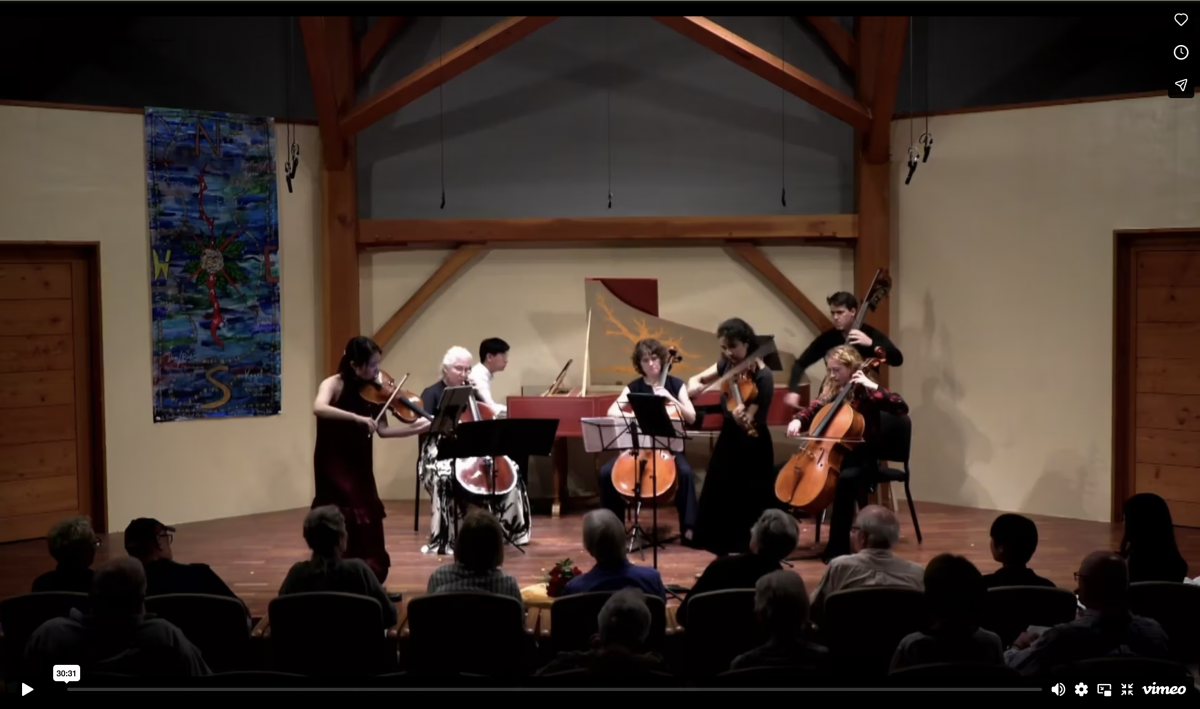
Dean Approach (Prelude to a Canon) (2017)
Johann Sebastian Bach (1685-1750) Brandenburg Concerto No. 6 in B-flat Major,
BWV1051 (1718)
Yeh-Chun Lin, Cara Pogossian, violas; Julia Lichten, Florianne Remme,
Madelyn Kowalski, cellos; Sam Suggs, double bass; Ryan Jung, harpsichord
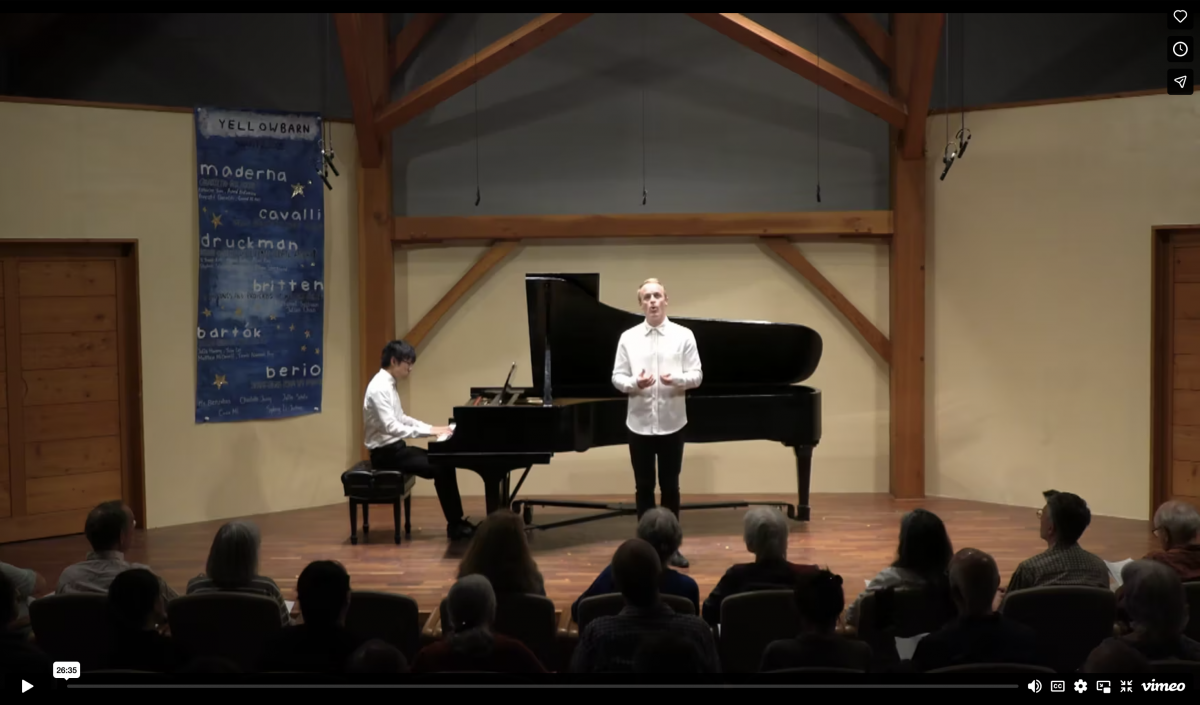
Benjamin Britten (1913-1976) Songs and Proverbs of William Blake, Op.74 (1965)
Nathaniel Sullivan, baritone; Julian Chan, piano
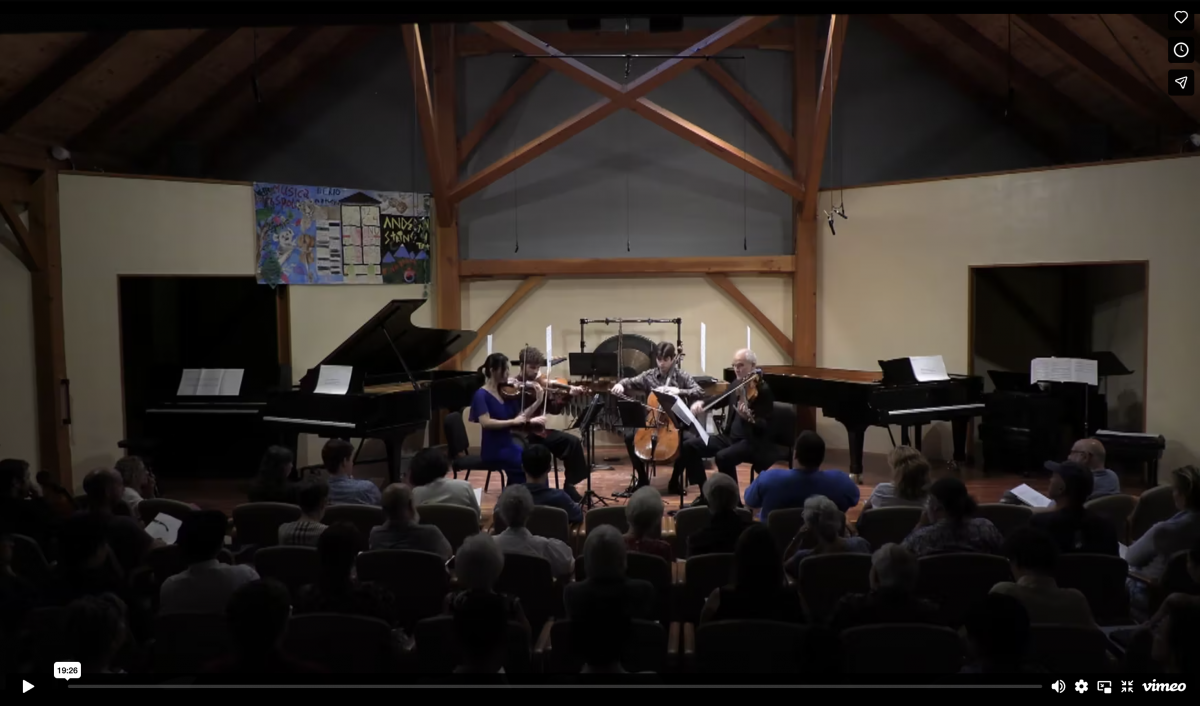
Julian Anderson (b.1967) String Quartet No. 4 (2023)
Yeim Lee, Ele Bienzobas, violins; Jonathan Brown, viola; Gerard Flotats, cello
Who is the other Mozart?
Nannerl Mozart was a child prodigy like her brother Wolfgang Amadeus, but her musical career came to an end when she was 18. A one-woman play puts her back on the stage. In September 2015, on the occasion of the 100th performance of her play The Other Mozart, actress Sylvia Milo writes about her inspiration and process.
"I am writing to you with an erection on my head and I am very much afraid of burning my hair”, wrote Nannerl Mozart to her brother Wolfgang Amadeus. What was being erected was a large hairdo on top of Nannerl’s head, as she prepared to pose for the Mozart family portrait.
It was that hairdo that drew my attention. Nine years ago I was visiting Vienna for the 250th birthday celebrations of Wolfgang Amadeus, and I was thrilled to explore the city following in Wolfi’s footsteps, many of which turned out to be Nannerl’s as well. At the Mozarthaus Vienna – Wolfgang’s apartment – on the exit wall, as if by an afterthought, there was a little copy of the Mozart family portrait. I saw a woman seated at the harpsichord next to Wolfgang, their hands intertwined, playing together. I grew up studying to become a violinist. Neither my music history nor my repertoire included any female composers. With my braided hair I was called “little Mozart” by my violin teacher, but he meant Wolfi. I never heard that Amadeus had a sister. I never heard of Nannerl Mozart until I saw that family portrait.
I was intrigued and determined to find out more. I read Wolfgang Mozart biographies, studied the situation of women and female artists during Mozarts’ time and in different countries, read writings of Enlightenment philosophers, conduct manuals … But the richest source of information came from the Mozart family letters. There are hundreds, and we have them because Nannerl preserved them. Most are written by Leopold and Wolfgang but some of Nannerl’s letters survived as well. Through these letters, sometimes only from the replies to her lost letters, Nannerl slowly emerged. I was able to understand the Mozarts as people, as a family, and through the lens of the times and the social situation in which they lived. I saw Nannerl’s potential, her dreams, her strength, grace and her fight.
Maria Anna (called Marianne and nicknamed Nannerl) was – like her younger brother – a child prodigy. The children toured most of Europe (including an 18-month stay in London in 1764-5) performing together as “wunderkinder”. There are contemporaneous reviews praising Nannerl, and she was even billed first. Until she turned 18. A little girl could perform and tour, but a woman doing so risked her reputation. And so she was left behind in Salzburg, and her father only took Wolfgang on their next journeys around the courts of Europe. Nannerl never toured again.
But the woman I found did not give up. She wrote music and sent at least one composition to Wolfgang and Papa – Wolfgang praised it as “beautiful” and encouraged her to write more. Her father didn’t, as far as we know, say anything about it.
Did she stop? None of her music has survived. Perhaps she never showed it to anybody again, perhaps she destroyed it, maybe we will find it one day, maybe we already did but it’s wrongly attributed to her brother’s hand. Composing or performing music was not encouraged for women of her time. Wolfgang repeatedly wrote that nobody played his keyboard music as well as she could, and Leopold described her as “one of the most skilful players in Europe”, with “perfect insight into harmony and modulations” and that she improvises “so successfully that you would be astounded”.
Like Virginia Woolf’s imagined Shakespeare’s sister, Nannerl was not given the opportunity to thrive. And what she did create was not valued or preserved – most female composers from the past have been forgotten, their music lost or gathering dust in libraries. We will never know what could have been, and this is our loss.
Director Isaac Byrne and I searched for the ghost of Nannerl, and the story she needed to tell in my one-woman play. Period-style movement transports us to the Mozarts’ time using delicate gestures, court bows and curtsies, and the language of fans.
To create the 18th-century world of opulence and of restriction, the set became an enormous dress which spills over the entire stage (designed by Magdalena Dabrowska), with a corset/panniers cage on top. Finally the hair stands as tall as Nannerl’s, after we found the right hairspray to hold it all up-up-up – and yes, it is all my own hair.
Creating music for the show was down to two composers, Nathan Davis and Phyllis Chen, who chose, rather than to try to re-create Nannerl’s compositions, to portray her musical imagination, using the sounds she would have had in her ears: the fluttering of fans, tea cups, music boxes, bells, clavichords.
I’ve been touring The Other Mozart for the last two years: this month marks its 100th performance, how fitting that it will take place just a few steps away from where Nannerl performed in London as a girl.
It has been a long journey to bring Nannerl back to England after an absence of 250 years. I sometimes feel like Leopold Mozart – on a quest to show the world this brilliant Mozart.
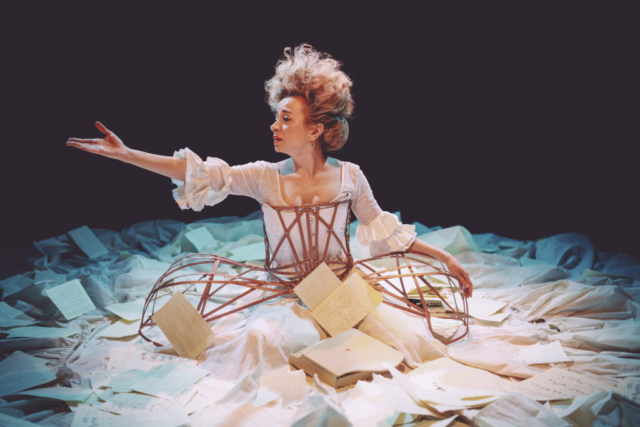
"Harriet, Scenes from the Life of Harriet Tubman"
On July 30th Yellow Barn's will present the American Premiere of Hilda Paredes' Harriet, Scenes from the Life of Harriet Tubman at the 2023 Summer Gala, followed by a general performance on July 31st. How did Harriet come to be, and what does it mean to perform it at a chamber music festival?
Hilda Paredes said, "After being invited by Universidad Nacional Autónoma de México to write a new opera, I asked my friend Claron McFadden if she would like to feature in this project and she immediately introduced me to Harriet Tubman. A six-year journey began then, discovering the extraordinary life and personality of Harriet Tubman. I always say and still think that if she had lived in the twentieth century she would have been awarded the Nobel peace prize."
After which Claron offered the following response by Zoom from Barcelona:
Find out more about the performance of Harriet at our Summer Gala on Sunday, July 30
Find out more about the general performance on Monday, July 31
Lei Liang's Six Seasons