
Music Haul Flip Side: Baltimore
"Every citizen a storyteller." On this Fourth of July we cannot resist remembering our incredible Flip Side poets. We are proud to share their work with you, alongside Jennifer Curtis, violin, Charles Overton, harp, and Chase Morrin, piano. Thank you to the families of Saint Luke's Youth Center and The Park School of Baltimore. As CJ Williams proclaims at the end of his poem to Langston Hughes and Beethoven: "Baltimore is beautiful!"
Learn more about Yellow Barn Music Haul's Flip Side: Baltimore
Yellow Barn’s 2023 Summer Artwork
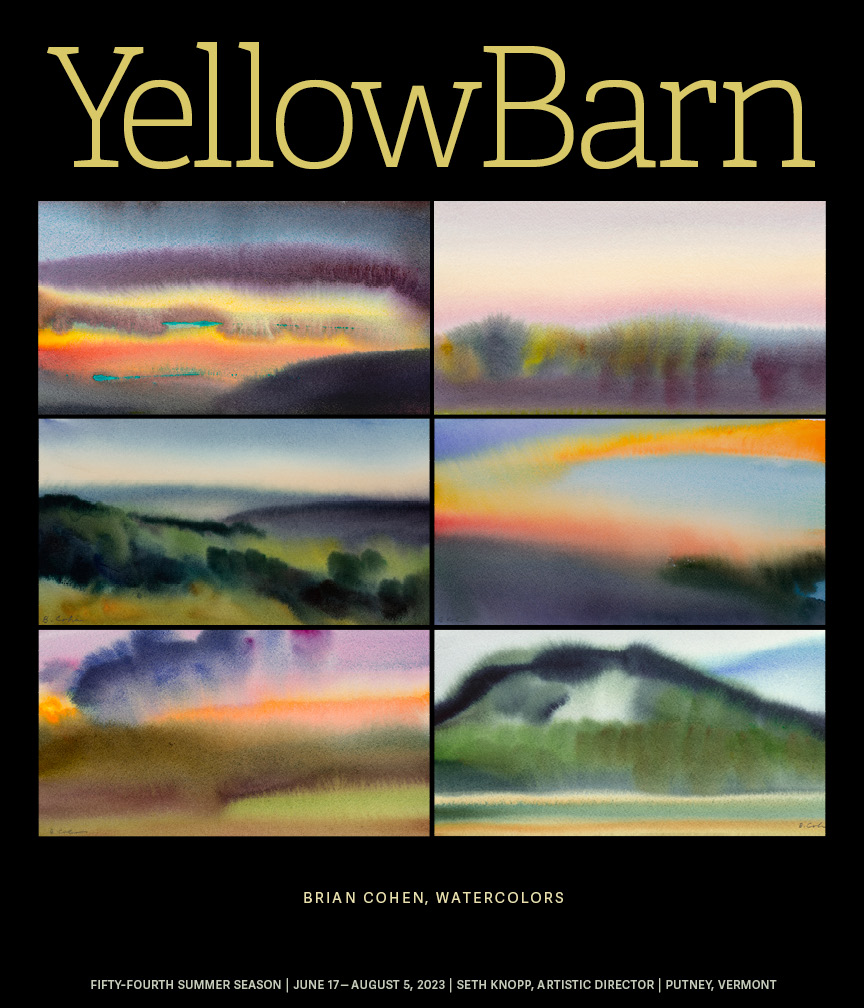
"Shut your eyes, wait, think of nothing. Now, open them ... one sees nothing but a great colored undulation...an irradiation and glory of color. This is what a picture should give us…a colored state of grace." (Paul Cezanne)I had been working in black and white for over twenty years before returning to my earlier infatuation with color. My watercolors are done on site, usually fairly quickly. I apply paint into wet paper, timing the drying of the paper as I lay in new washes of color. Painting in the landscape lets me sit happily observing light, color, and shape, simplifying or obscuring detail in favor of larger forms and the broader swell of color. I aim for a “color chord" or harmony that speaks of time, light, and distance all at once.—Brian Cohen
Beethoven Walks at the Nasher


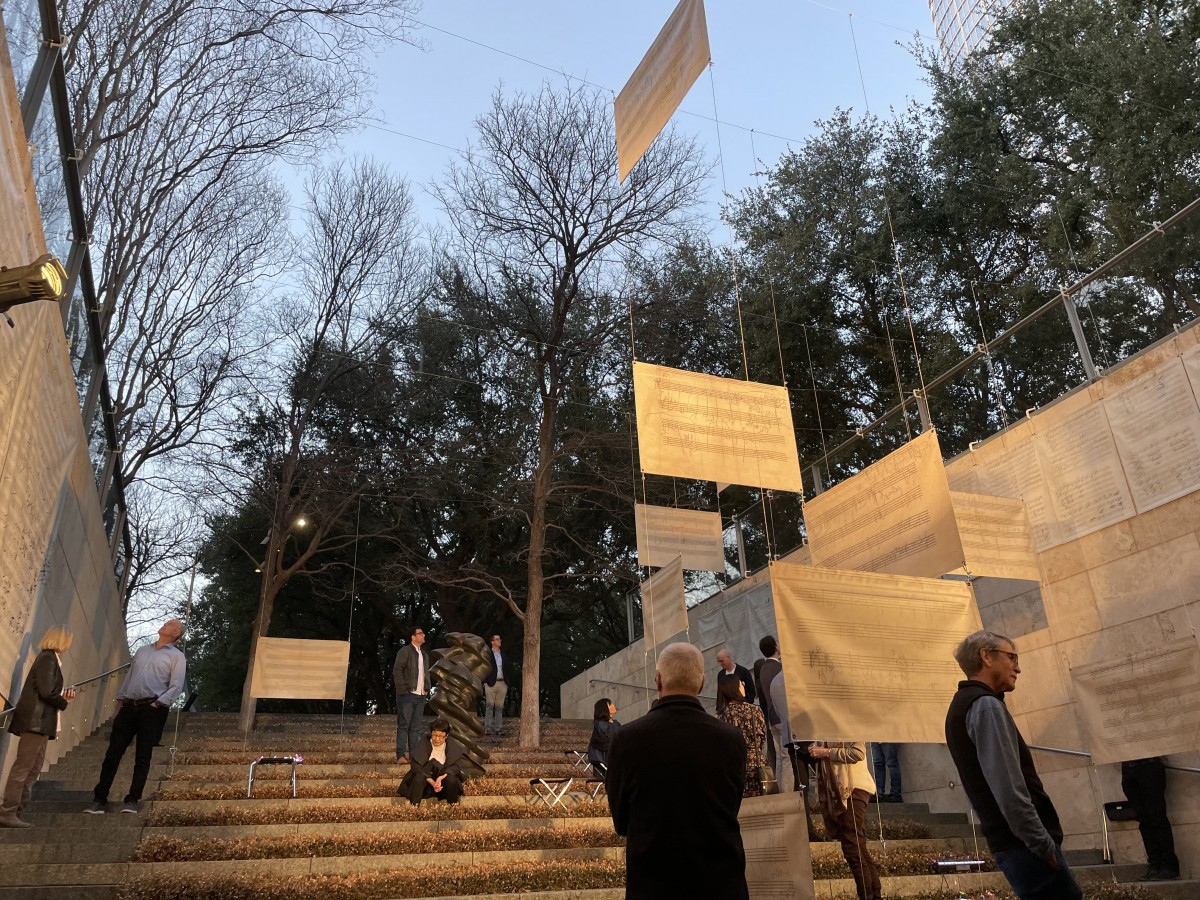
Seth Knopp's Beethoven Walks at the Nasher, commissioned by the Nasher Sculpture Center in Dallas, TX, opened on February 5, 2023 and will remain open until May 21, 2023.
Ludwig van Beethoven left behind a vast visual record of his compositional process, a staggering reflection of the humanity that defines his music. Beethoven Walks at the Nasher Center incorporates sketches and the autograph manuscript with a recorded performance of one of the composer’s most profound and personal musical utterances, his “Heiliger Dankgesang eines Genesenen an die Gottheit, in der lydischen Tonart (Holy Song of Thanksgiving to the Deity from a convalescent, in the Lydian mode), the third movement of his String Quartet, Opus 132 completed in 1825.
View the visitor guide and listen to the recording
Recording:
Takács Quartet
Edward Dusinberre and Károly Schranz, violins; Roger Tapping, viola; András Fejér, cello
Used with permission from Decca
Beethoven Walks at the Nasher is dedicated to the memory of Roger Tapping, one of the great chamber musicians of our time and a beloved Yellow Barn faculty member for nearly 20 summers. The opening event took place on February 5th, Roger's birthday.
About Beethoven Walks
Beethoven Walks is a project begun in the early spring of 2020 during our collective isolation, serving a universal need to better understand our humanity through music and the beauty of our world. The first installations, produced by Yellow Barn in Putney, Vermont, spanned four miles of woodland trails and included nine works by Beethoven accompanied by over 180 pages of sketches and autograph manuscripts. Beethoven Walks at the Greenwood School in Putney remains open to the public.
Find out more about Beethoven Walks
Beethoven Walks was imagined and created by Seth Knopp and produced by Catherine Stephan.
Acknowledgments for Beethoven Walks at the Nasher
Banners
Howard Printing
John Kramer Design
Op.132 Autograph sketches and manuscript
Staatsbibliotek zu Berlin
Op.132 Recording
Decca Music Group, Ltd. (2004)
Installation
Nasher Sculpture Center
"Trust is key."
On July 15, 2023, Jeremy Eichler visited Yellow Barn's summer festival, and subsequently wrote about his Barn experience for the Boston Globe:
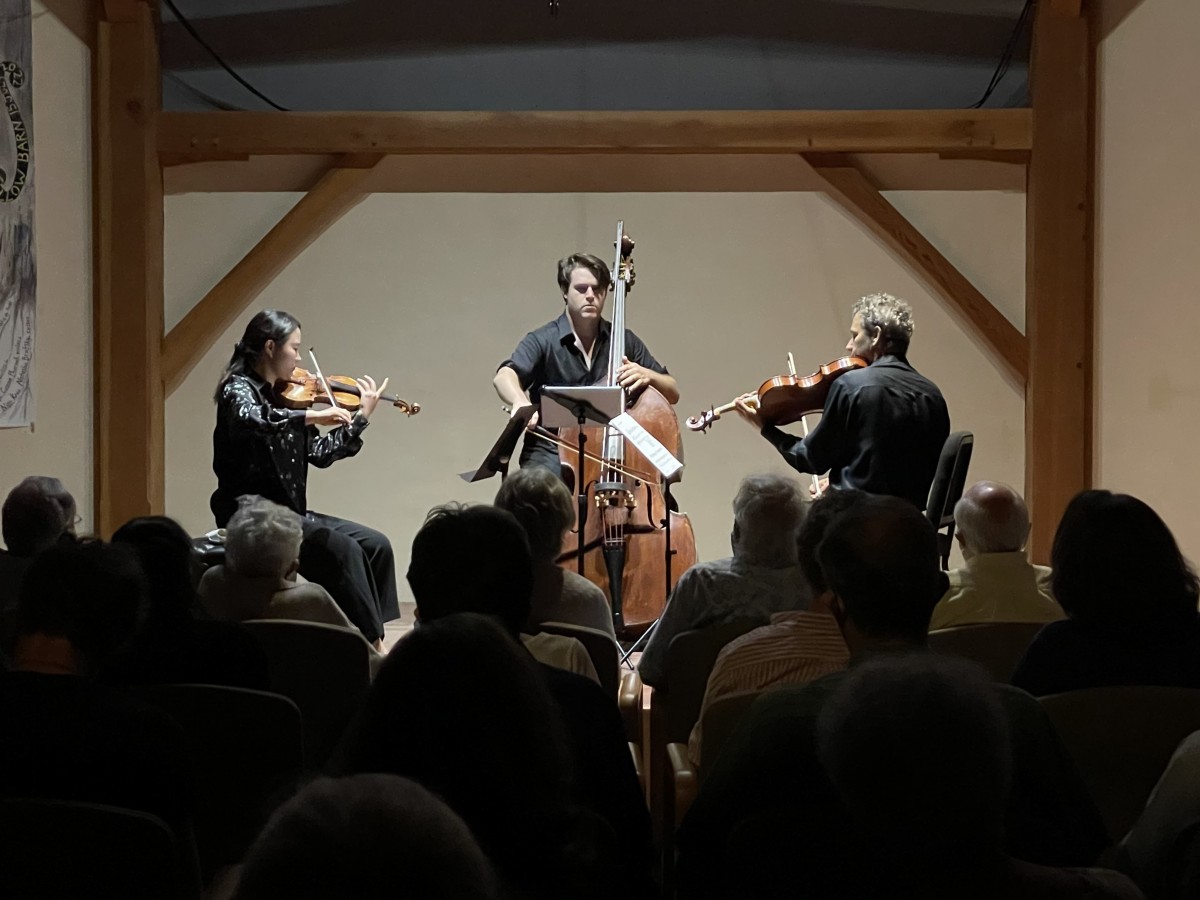
SoYoung Choi, Sam Suggs, and Nicholas Mann perform selections from György Kurtág's "Signs, Games, and Messages" in the Big Barn
Kurtág, Brahms, and Symanowksi, with blueberries on top
On Friday night, the Yellow Barn music festival once more served up a bracing mix of old and newBy Jeremy Eichler, Globe Staff
PUTNEY, VT — A casual passerby could be forgiven for their raised eyebrows. On Friday evening, outside the general store in this small Vermont town with a population of just over 2,600, a group of students could be heard debating the merits of a particular Debussy arrangement with feisty undergraduate zeal.
Chamber music insiders, however, would be less surprised by the scene. Every summer for 53 years, dozens of advanced students and early-career musicians descend on Putney, where they join a loyal group of faculty members at a progressive-minded music festival known as Yellow Barn. Now in its 25th year under the imaginative leadership of artistic director Seth Knopp, the place runs less like a traditional festival and more like a laboratory for rethinking what a chamber concert might try to do and to be.
Trust is key. Knopp and executive director Catherine Stephan seem to have weaned audiences from the widespread habit of turning out based on the names they recognize from the program. At Yellow Barn, an audience member may know none of the players on a given night, and may have never heard of 80 percent of the repertoire. No matter. They know the program will likely cohere artistically, that the performances will be deeply committed, and that they will probably leave having discovered something bracing and new.
The current season at Yellow Barn, which runs through Aug. 6, honors the memory of Roger Tapping, a distinguished violist who played in both the Takacs and Juilliard Quartets, and a much-loved Yellow Barn faculty member who taught participants across multiple decades. Friday night’s program was one of several this summer featuring music with which Tapping was particularly connected — in this case, works by Brahms, Szymanowski, and the Hungarian master György Kurtág.
Kurtág may be the least well-known of these three composers, but on Friday’s program, the laser-like intensity and haunting eloquence of his music overshadowed just about everything else. It’s for good reason that, at 96, he may be the most revered composer alive today. His music posits modernism itself as a kind of broken mirror in which the vibrations of a century riven by unimaginable violence commingle with the fractured yet still-glowing fragments of the self.
Friday’s program opened with selections from Kurtág’s series “Signs, Games, and Messages,” performed by a trio of strings (SoYoung Choi, violin; Nicholas Mann, viola; and Sam Suggs, bass). The first short work, “Virág az ember, Mijakónak,” offers up elemental musical gestures rendered with heavy practice mutes clamped onto the bridges of all three instruments, dampening their resonance and cutting their volume beneath that of a whisper. In lesser hands, the effect might seem like a gimmick, but not here. Kurtág’s music often dramatizes the existential struggle for expression itself, and “Virág az ember, Mijakónak” speaks in this vein, as if each note were painstakingly wrested from an abyss of silence.
When coaching players in his own music, Kurtág famously brooks no compromise, demanding highly exacting performances. Fortunately, that is precisely what Friday’s trio offered, rendering the opening selection and 10 others from this series with precise technique, interpretive vision, and impeccable musicianship. The audience listened with rapt attention.
Perhaps inevitably, most of the remainder of Friday’s concert receded from these Kurtágian heights, with festival participants strolling more casually in the meadows below. Mezzo-soprano Rebecca Printz and pianist Chaeyoung Park sauntered through an involving set of Szymanowski songs. And an assemblage of faculty and younger festival players gamely took on Brahms’s immortal B-flat Major String Sextet.
The Sextet’s glorious theme-and-variations Andante may be its best-loved movement, and when listening to a live performance, one rendition never feels like quite enough. Happily, on this occasion, we heard it not once but twice thanks to Qing Jiang’s spirited and tonally robust account of Brahms’s solo piano arrangement of that very same movement.
With COVID-19 still in the air, the festival hall (known as “The Big Barn”) is technically limited to 60 percent of its usual capacity, but on Friday, with participants lavishly cheering their colleagues from the balcony, the space felt as full as ever. And yes, in case you were wondering, at intermission the festival still serves its trademark snack of local blueberries on vanilla ice cream. To be sure, Yellow Barn is back — and there is no place quite like it.
The Strad features Music Haul
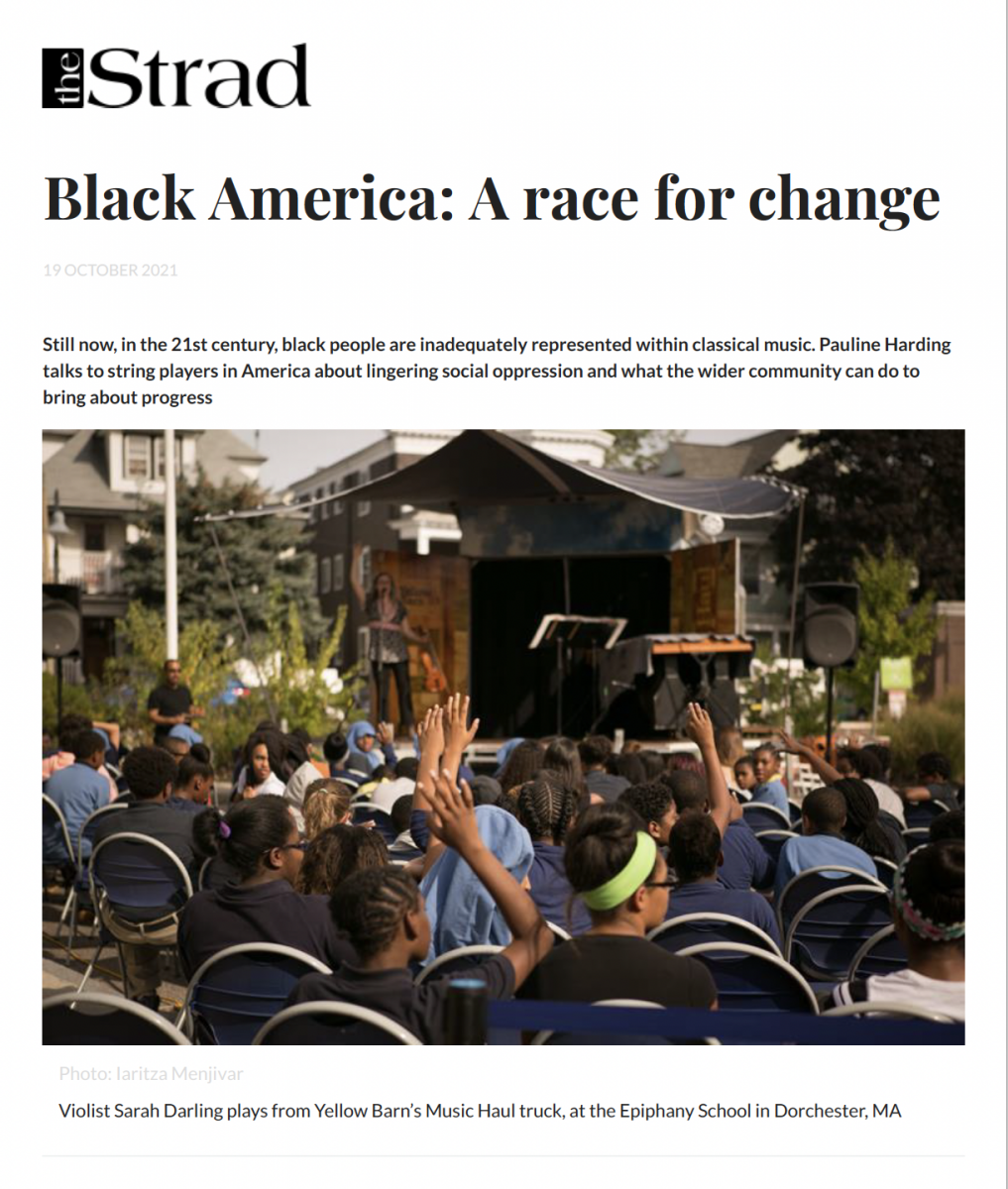
"At the same time, traditional classical music can be just as popular in any socio-cultural context, and bringing it into new spaces is key. The Yellow Barn festival in Vermont has found similar success by driving its Music Haul truck into different neighbourhoods and converting it into a pop-up stage in front of new communities and audiences. Most important of all...is that musicians of all colours and backgrounds engage with these audiences repeatedly."
Read about Yellow Barn Music Haul in The Strad's "Black America: A race for change"
Find out more about Yellow Barn's collaboration with The Epiphany School
Yellow Barn’s 2021 Summer Artwork
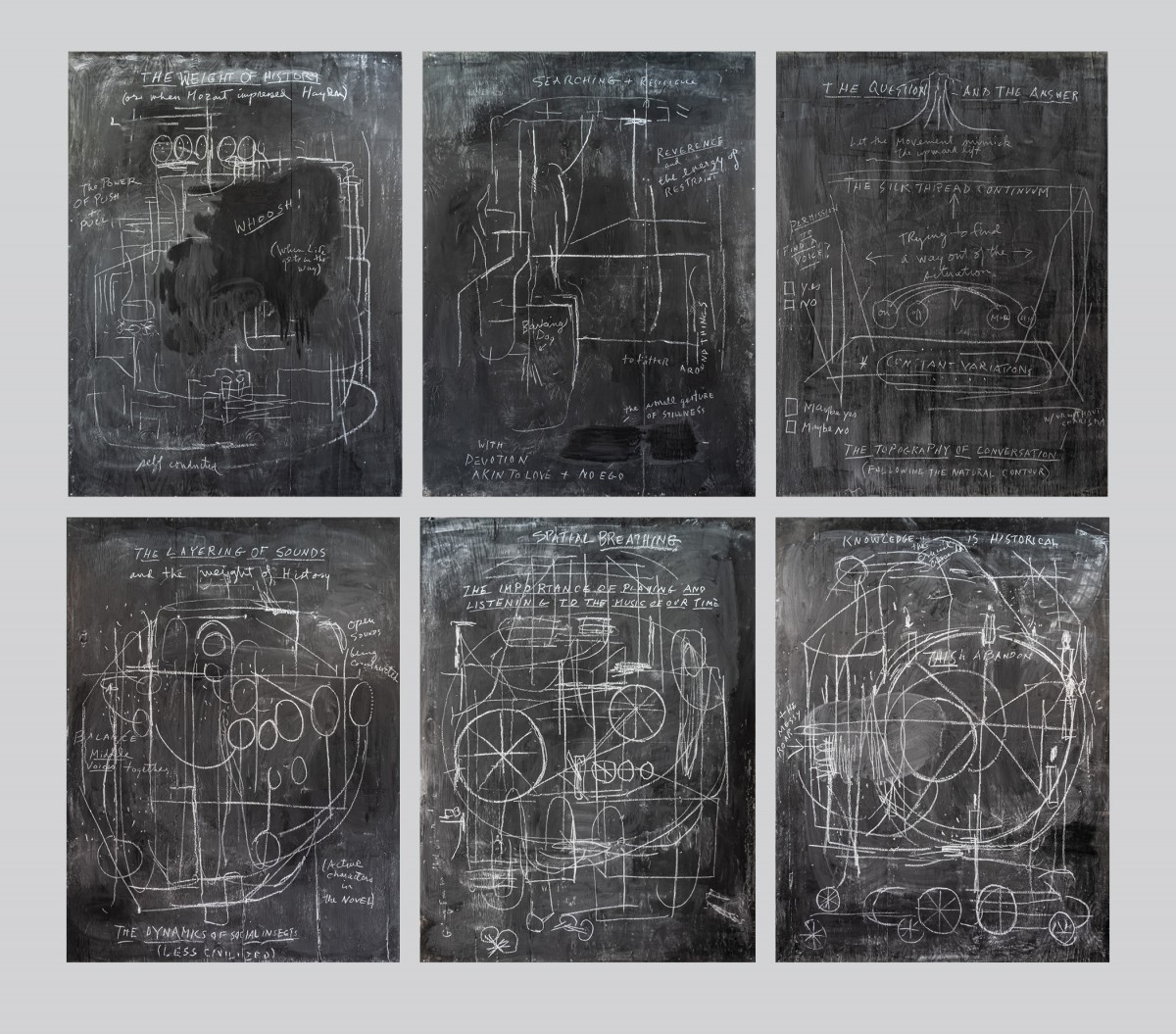
Imaginary Lectures by Ann Glazer (2019 Artist in Residence), a series of six chalk drawings with words collected from rehearsals and performances at Yellow Barn View larger
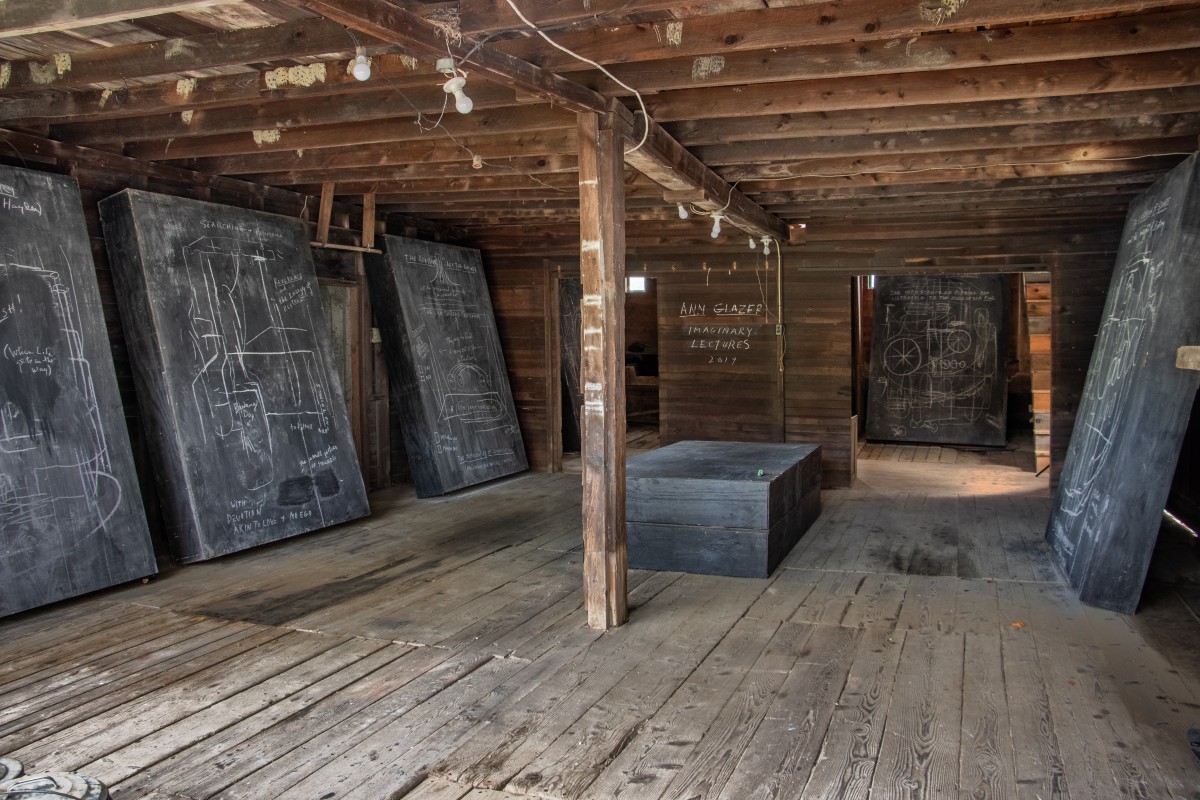
Ann Glazer creates works that cross mediums. Her experimentation with process evokes personal narratives of everyday life.
Glazer received a BA from Brown University and an MFA from the Art Institute of Chicago. She was awarded fellowships from the Dallas Museum of Art and the Art Institute of Chicago. Her work has been shown at the Museum of Contemporary Art, North Miami (MOCA), The Torrance Art Museum, Torrance, CA; the Reading Room, Dallas; Women & Their Work, Austin; Dallas Center for Contemporary Art, The McKinney Avenue Contemporary; and Barry Whistler, Conduit, AIR (NYC), DW, Kirk Hopper Fine Art and Liliana Bloch Galleries.
Ann Glazer lives and works in Dallas and New York City.